A Warm Car Between Installations: Britain's Winter Light Trails by Chauffeur
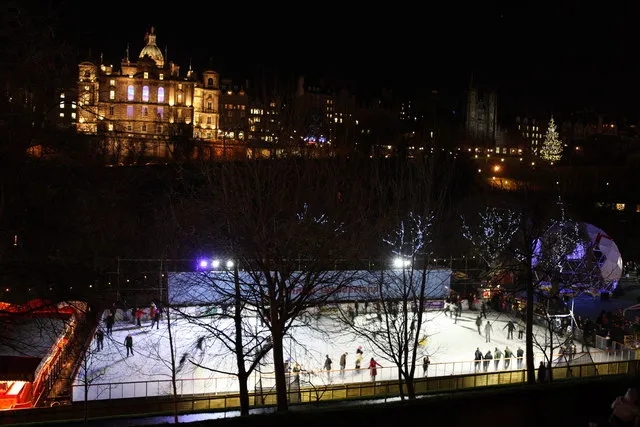
Photo: Calum McRoberts, CC BY-SA 2.0, via Wikimedia Commons
Winter light trails have become Britain's answer to the short December day: a procession of illuminated trees, projected follies and hot chocolate stands that gives the season an after-dark ritual. They are also, almost without exception, timed-entry events with one-way routes, distant car parks and a cold walk at either end. The spectacle is the point; the logistics are not. A chauffeur does not merely remove the drive. It restores the interval between installations — the warm car, the flask, the quiet debrief — that turns an evening out into an occasion.
Why the back seat suits the season
Light trails are linear by design. Visitors arrive in a slot, follow a route and emerge, frequently, at a different gate from the one they entered. In a private car this would mean a cold walk back to an unfamiliar car park, or a scramble for a taxi in a village with three of them. With a chauffeur, the car is a constant: warm, waiting and briefed on the exit point. The driver knows the designated drop-off, the holding lane and the difference between the satnav pin and the actual gate. That is the whole argument for the back seat in winter.
Kew Gardens, London
Christmas at Kew remains the benchmark, and it is also the busiest. Timed slots run from late afternoon, and the pedestrian gates operate with a discipline that rewards early arrival. Chauffeurs should use the operator's designated drop-off at Victoria Gate or Elizabeth Gate, with the driver holding off Kew Road rather than circling. The car becomes a base for a late supper in Chiswick afterwards, when the District line is full and the pavements are wet.
Westonbirt, Gloucestershire
Enchanted Christmas at the National Arboretum is a woodland trail of unusual quality, and its approach lanes are correspondingly narrow. The main visitor centre drop-off is straightforward; the car parks are not. A driver should park off-site and return on call. The A433 can be slow in the early evening, so build in a buffer. After a mile of illuminated arboretum, the prospect of a pre-warmed car is not a luxury but a sensible conclusion.
RHS Garden Wisley, Surrey
Glow at Wisley serves the Surrey and south-west London market well, but the A3 and M25 approaches demand planning. Use the main car park entrance drop-off and avoid the final ten minutes before a timed slot. The driver can wait at Wisley village or a nearby service area, returning to the agreed point once the trail concludes. For corporate guests travelling from London, the garden makes an unusual and civilised alternative to a restaurant evening.
Blenheim Palace, Oxfordshire
The Illuminated Trail at Blenheim is a grand-scale production, and the palace forecourt operates separate car and coach lanes. Woodstock traffic can be tight; a driver should hold in the town rather than attempt to queue at the gate. The trail ends away from its start, so confirm the pick-up gate in advance. This is precisely the sort of estate where a chauffeur's local knowledge is worth more than the car's specification.
Longleat, Wiltshire
The Festival of Light turns the estate into a nocturnal safari of lanterns and light installations. The distance from the entrance to the house is considerable, and rural lanes reward a driver who has recce'd the route. Drop at the main house courtyard where permitted, otherwise at the visitor centre, and allow fifteen minutes from gate to collection. The car should remain locally available rather than returning to Bath or Salisbury between slots.
Edinburgh Botanic Garden
Christmas at the Botanics is a city trail with a residential perimeter, which makes drop-off discipline essential. Use the Arboretum Place gate and have the driver hold in Inverleith rather than idling on adjacent streets. The evening is cold even by Scottish standards, and a warm car between the garden and a Stockbridge dinner is the difference between a pleasant night and a memorable one.
Bodnant Garden, Conwy
For a lesser-known trail, Bodnant in the Conwy valley is hard to beat. The National Trust garden uses narrow valley roads and timed slots, and the weather can turn quickly. Drop at the main entrance and have the driver park at Tal-y-Cafn or Eglwysbach. This is weekend-travel territory: a Welsh garden, a country-house hotel and a chauffeur who understands that the drive is part of the occasion, not an interval to be endured.
The practical choreography
Book timed entry first, then the car. Share the slot, the gate and any accessibility requirements with the operator at the time of booking, not on the day. Confirm the designated drop-off rather than relying on a satnav pin, and establish where the driver may legally wait. Ask for the car to be pre-heated, with water and blankets aboard. Keep the driver's number to hand, and agree a twenty-minute buffer between the end of the trail and the next reservation. A one-way route can end a quarter of a mile from where it began; the chauffeur should know that before the passenger does.
Booking the run
Worldwide Chauffeur Drive treats a winter lights evening as an itinerary rather than a transfer. For the 2026 season, the sensible approach is two trails in a weekend, not four: one grand production and one quieter garden, with a hotel and a dinner between them. The car is the constant, and the back seat is where the evening is allowed to settle. That is the quiet luxury of the winter lights run — not the spectacle alone, but the absence of everything that would otherwise intrude upon it.